Friday, 4 October 2013

Digital art

 
The Workstation 2 by Jujika

Digital art is the making of art through digital platforms, such as Photoshop or GIMP. Many people who draw digitally use graphic tablets, and while that makes drawing digitally so much easier, it also takes some time to get used to, and even after years of practice, people may still find traditional pencil and paint easier to do. However, digital art also has some extremely convenient functions, like the undo button for one. I myself is more used to painting digtally, so I find that easier than painting traditionally, but others may have a different view of this. No matter which one people prefer, though, I see both as a form of art, not any better or worse than the other.

Kagerou Project


Kagerou Project, abbreviated as Kagepro, is a series of songs that tell the story of children with red eyes and 'eye abilities', composed by Shizen-no-teki-P (or more commonly known as Jin) and artwork and videos by Shidu and Wanyannpu. The series has been wildly popular on Nico Nico, and has released two albums so far. It also has several novels and a manga, and soon anime, adaptation. 

The story begins with a seemingly normal scenario, disregarding some not-so-normal details such as a AI girl living in our protagonist's electronic devices. Said protagonist, Shintaro, is a hikikomori, who has dropped out of school despite his extremely high IQ, and have never left his house for two years. That is, until he finds his computer broken. He then proceeds to go to the department store and, instead of buying what he needs and peacefully return to his shut-in lifestyle, the department store gets attacked by terrorists, and he becomes one of their hostages. Meanwhile, his younger sister, Momo, a popular idol, encounters Kido, who is apparently the leader of the 'Blindfold Gang', which has just 4 members at that time, all children with eye abilities. Momo discovers that she has the 'attracting eyes' ability, which was partly what enabled her to be so popular. She tags along and eventually encounters her brother, and together with the gang, they use their abilities to save the customers of the department store. Shintaro and his AI, Ene, who also has an ability, are forced to join the gang soon after. Strangely enough, Shintaro does not have an ability like the others. Later on, the story slowly unfolds and shows the reason why Shintaro became a shut-in, the significence of that reason, and eventually, the creator of those abilities. Their abilities are helpful, but they were obtained at a great cost - the life of someone they hold dear. This is shown best in the song Kagerou Days, or Heat-Haze Days. Two children, Hibiya and Hiyori, were forced to loop each other's deaths repeatedly, apparently for more than 10 years, inside the heat-haze. It only ends when one of them breaks out of the daze, while the fate of the other is unknown. Hibiya broke out and obtained an ability, but Hiyori's fate remains unclear. 

It is highly speculated that the one left in the haze dies, or simply joins the creator of the haze in it forever. The series gets darker towards the end, and eventually the story seems to get a 'bad end' where everyone dies. But then the timeline is reset, and they apparently obtained a 'good end' eventually.

Kagerou Project: August 15th Tumblr Collage

Image is arranged by Hama (yuukeiyesterday.tumblr.com)
The collage's main page is here!

Back in August, I participated in a art collage for Kagerou Project. It was certainly very interesting to see so many artists' art put together, and many of them are so well done! It's clear that they put in lots of effort into their works. Mine was really rushed, though. I literally submited right on the deadline. It's kind of embarssing to look at now, the colouring was clearly rushed and overall rather...terrible. If you're curious, it's the fourth picture on the top row. Hama, the organiser of this collage, requested that participants include some form of red in their pictures, to have a colour scheme for the collage, though it wasn't necessary. Many of us still threw a bit of red where we could, though, so the results look quite harmonised.

Kagerou Project: Summertime Collage

Image arranged by Hiyo (hiyori-asahina.tumblr.com)
Collage's main page can be found here!
Recently (about a week ago), I participated in another collage! I decided to actually put in some effort this time round (since the previous one was rather...horrible) and did the drawing earlier so I'd have time to check for mistakes and play with colours, because my colour sense isn't exactly the best. My submission is on the third row, tenth from the left! This time, no colour schemes were suggested, but many people seemed to use blue as their background, so the overall image appears really calm and bright.

Apparently Hiyo is going to add the pictures of those who couldn't make it in time into the collage later. I'm really looking forward to it, since everyone's art is so good! Other than that, their art put together in the collage also showcases the lives of the cast, both happy and sad.

Bookmark of Demise Project


終焉ノ栞 by Saine
Shuuen no Shiori Project, commonly refered to as Shuuenpro, is a song series by 150P and Suzumu, with character designs and art by Saine, Komine and Kara, revolving around urban legends, supernatural happenings and mostly, the ugly sides of humans. Personally, I adore this series, for it shows that even the most perfect and sociable people have faces that are hidden to the rest of the world. This series has two song albums released so far, and one novel (with an upcoming one, that's two) and a manga adaptation. A strange feature of this series are the character names. Instead of normal names, they are simply referred to as A-ya, B-ko, C-ta, and D-ne. This is a reference to japanese broadcasts, where culprits and victims in murders and such are unnamed. This is highly relevant to the story, as I will summarise in a bit. 

The first chapters are shown in A-ya's perspective, seemingly implying that he is the protagonist of the story. They show the four finding a old diary from ten years ago, which contains the instructions to summon the book and bookmark of demise, throwing all involved into the demise game. When started, the game will not end before they find and kill the 'traitor', who is apparently someone among them. After performing the ritual, A-ya himself recieves an instruction from Kokkuri-san, which the rules of the game forbid from showing to anyone who isn't a participant. However, a classmate sees it, and he dies soon after, having his body split in half at the waist. A-ya blames himself for that, as he was the one who showed it to the classmate, curious about the results. During his stay at home due to the school being closed for investigation of said classmate's death, he recieves something else - the book and bookmark. They contain the steps for performing one-man hide-and-seek, and he has to do it before a week passes, or he will die. He plays it, but summoned something else that was completely out of his expectations. He dies during the game, and is reported 'with various stab wounds all over his body' in the news the next day. 

 Similar things happen in the other three's chapters, such as B-ko dropping her friendly façade as soon as terror takes over, and eventually becomes distrusting and fearful upon receiving her own instructions, to 'avoid her doppelgänger'. C-ta, on the other hand, is revealed to be spying on A-ya, obsessed with 'being A-ya's hero', and is the one who eventually kills him due to paranoia, suspecting that he isn't the 'real' A-ya, but simply an 'imposter'. He uses his talent to freely manipulate his popularity in class to control all of A-ya's connections, save B-ko. D-ne appears to be a innocent, polite girl, but is actually, as Suzumu describes, mentally ill. She is obsessed with the 'perfect girl', which she has recognised B-ko as, and claims to be in love with her. She later obtains the monkey's paw, which enables the owner to make five wishes, but they all come at a price. Her obsession goes so far that she makes wishes that bring her closer and closer to being B-ko, and eventually replaces her, becoming her doppelgänger. 

The first novel ended on a dark note, showing that all that had happened was the 'worst end' before looping the beginnings over and over again. It has been implied that there is no traitor at all, and the demise game is just an endless loop where they suspect and doubt one another. There is speculation that the traitor is actually their own distrust of one another, and the game will end when the four starts to trust each other and face the demise game together. This series explores the darker sides of the human mind, and depicts how selfishness and unwillingness to trust and confide in others eventually leads to destruction. While this is labelled as 'horror' due to the deaths and urban legends involved, I would say that those are only the trigger, and the rest of those 'horrors' are caused solely by the four.

Sunday, 29 September 2013

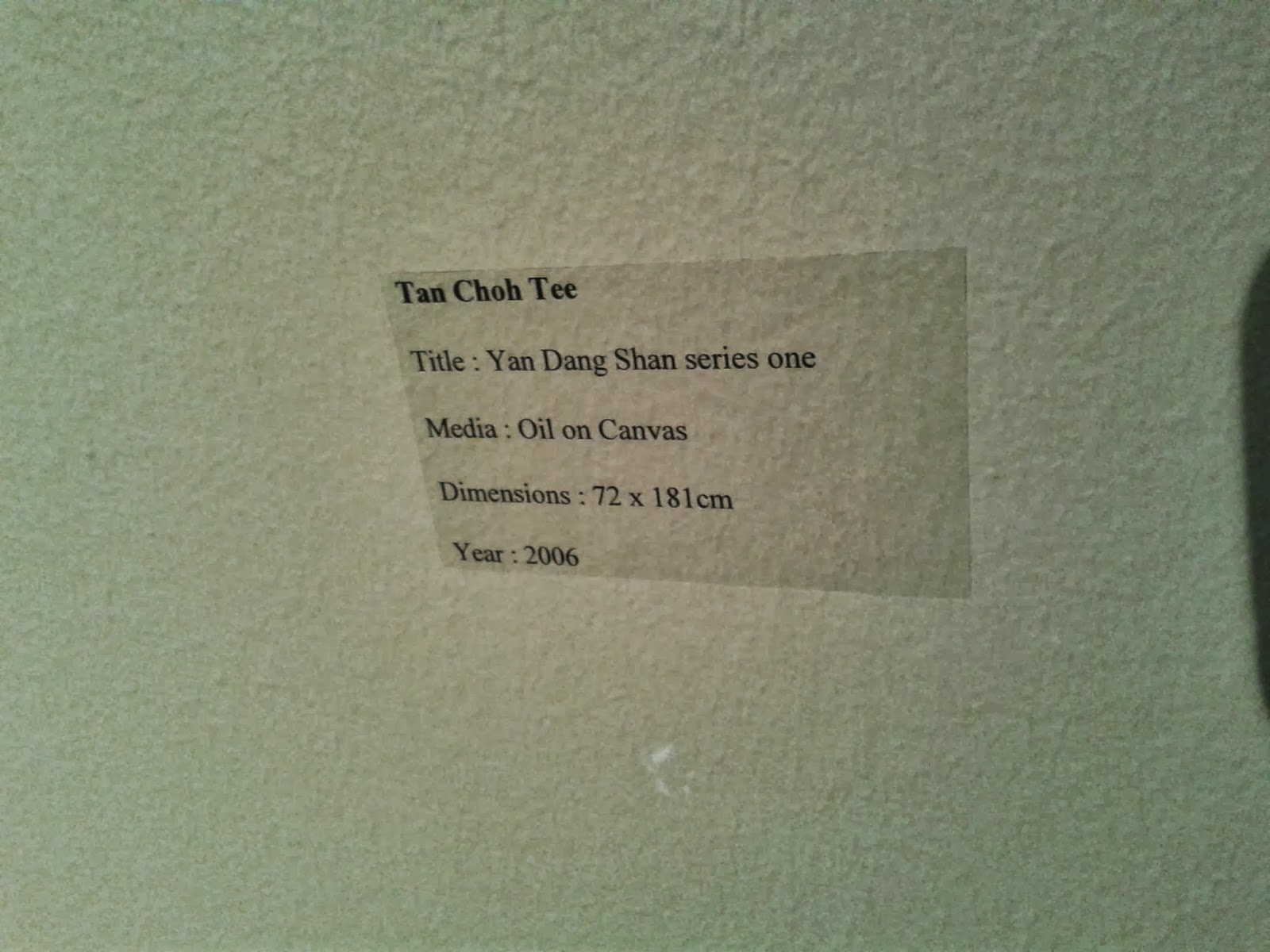
Yan Dang Shan series one


The Yang Dong Shan series one, a work of Tan Choh Tee, depicts a vast mountain landscape. The mountains and skies are delicately painted with powerful strokes, and thus i presume that the artist simply wanted to capture the beauty of the mountain, the moment of awe as the greatness of the scene overwhelms him. I believe that he wanted to replicate that exact moment into the canvas.

Manbo-dead-behind-the-house-P

by Manbo-P feat. Gumi

That is his official title, but it's quite a mouthful, so I'll refer to him as Manbo in this post. Manbo is a producer of songs on Nico Nico Douga, similar to Neru, whom I have posted about before. His songs are generally wacky and often makes no sense, or at least, far exceeds the normality that people are used to. A fire extinguisher for a butler? Check. Chopping a stag beetle and getting transported into the future? Yup. A bad-tempered loquat growing on a person's brow? He has it. Despite so many humourous titles, however, some of his other works are rather heart-warming, and perhaps heart-wrenching, too. 

One of them has a boy waiting for his beloved to return for 15 years as he continues to write letters to her, not knowing that she was already dead. Or rather, he had amnesia, due to not wanting to accept that fact. 

Another has a tengu (a creature in japanese mythology, often shown with long noses) coming to earth, and is tasked to 'make himself useful' by the third year. He was also not allowed to give his identity away, and has to live as a normal human. He does spill this to a human friend, though, and they, along with 3 others (2 of which were also supernatural creatures) made a band. When they finally got the chance to have a proper performance, though, the tengu hurt his hands and is unable to play the guitar. Unfazed, he used his nose instead, and they enjoyed themselves one last time before he was forced to return due to revealing his true nature. 

The final one I'm going to talk about is a mini-series, Fools Among the Stars, which stars Orihime and Hikoboshi, two deities who were deeply in love with each other, but were seperated and can only meet with one another once a year, on Tanabata. However, Tanabata is always rainy, and thus they have very little chance of meeting. This legend is very similar to a Chinese one. The story is told in 3 songs, from Orihime, Hikoboshi, and a Kappa's (another creature in japanese myths, a water spirit of sorts) perspective. The first 2 songs were generally light-hearted, as they tell the story of how Orihime decided to hire demons to do work for a horrendously low pay and becoming a successful businesswoman, and Hikoboshi, who traveled up a mountain, chased a group of IT students away from a lodge, and becoming a disciple of the Muscle God. The third song, however, takes a turn for the worse (or better?). It is revealed that a Kappa is needed to cross the river that separates the two, and as Hikoboshi finally manages to get one of those, he travels across the river to find a aged Orihime. It turns out that the river between them was a river of time, and while they finally meet each other, their happiness was short-lived.

Of course, all of these songs wouldn't be quite complete without the gorgeous art by Manbo's sister, referred to as Tsukasa Ryuuguu. Her style is very simple, yet her colour choices and overall composition results in a beautiful piece of work.